Animal Scents: Safe, Risk-Free Aromatherapy for Your Dogs and Cats
Oh, my beautiful Esseniq people! Those of us who are dog or cat moms know that our furry friends aren't just pets; they're family. They are the little eyes that wait for us eagerly, the purr that contributes to our soul's well-being, the bark of joy that reminds us how beautiful life is. And just as we strive to create a home free of toxic chemicals for ourselves, how could we not do the same for them? Because, you know what? They also deserve to breathe fresh air, feel the tranquility of a safe environment, and live in a space that nurtures their well-being, always with that touch of unconditional love that only we know how to give.
But how do we achieve this when it comes to essential oils? Ah, therein lies the magic and the responsibility. Aromatherapy can be a prodigious ally to support emotional balance, comfort their little skin, or simply neutralize those "wet dog smells" that sometimes sneak into the house. But, be careful! The key lies in knowledge and prudence. Because what is good for us is not always good for those four-legged beings who depend so much on our care. Let's delve into this fascinating world, always with safety and love as our guide.
The Superpower of Their Nose: Understanding Animal Olfaction
Let's imagine for a moment… We close our eyes and try to identify the aromas that surround us. Maybe freshly brewed coffee, the shampoo in our hair, a soft air freshener. Now multiply that capacity by up to 100,000 times! That is the olfactory world of a dog. And a cat's, while not as powerful as a canine's, is still infinitely more sensitive than ours.
This means that what for us is a drop of diluted essential oil for a subtle scent, for them can be an olfactory hurricane. This hypersensitivity is not just a curiosity; it is a central piece in the puzzle of safe pet aromatherapy. Their vomeronasal organ (or Jacobson's organ) allows them to detect pheromones and chemicals we can't even imagine, directly influencing their behavior and mood.
That's why the golden rule, the one we must have engraved in our souls, is: Always offer them the choice to leave. How? If we are diffusing essential oils, it is imperative to leave the door of the room open so that our furry friend can come and go as they please. If the scent becomes overwhelming or unpleasant, they will have the freedom to retreat to a space with fresh air. We should never force them to stay in an environment where a diffuser is active.
Furthermore, we must start with an extremely small amount and high dilution. Think of an "extreme dilution" as the starting point. One drop in a diffuser with 100-200 ml of water is more than enough to start in a large space, and always for short periods of 15-30 minutes, with an exit option available.

Dogs vs. Cats: Not All Metabolize the Same
This is where the most important and critical part of our guide comes in, my people, and where science lends us a hand to protect our little ones. We cannot treat a dog and a cat the same way when it comes to essential oils. They have different physiologies, and knowing these differences is not just a responsibility—it's pure love!
The key is in the liver: Cats, unlike dogs and humans, lack a crucial liver enzyme, glucuronyltransferase. This enzyme is fundamental in the glucuronidation process, a detoxification mechanism by which the liver conjugates fat-soluble compounds to make them water-soluble, so they can be eliminated from the body through urine. Without this enzyme, certain chemical compounds present in essential oils accumulate in a cat's system, leading to severe toxicity.
This makes them extremely sensitive to various metabolites that are harmless to us. It is for this reason that oral administration in cats is a resounding "NO," and topical application must be done with the utmost caution and dilution, or, preferably, AVOIDED with oils that are not specifically for them.
Essential Oil Safety Chart for Pets
| Feature / Oil | Dogs | Cats |
| :--- | :--- | :--- |
| Generally Safe Oils | Lavender (Lavandula angustifolia), Frankincense (Boswellia carterii), Copaiba (Copaifera officinalis), Thieves blend (with caution and high dilution), Geranium (Pelargonium graveolens), Roman Chamomile (Chamaemelum nobile). | Lavender (Lavandula angustifolia), Frankincense (Boswellia carterii), Copaiba (Copaifera officinalis). Only through extremely light and passive diffusion, always with escape routes. Extreme topical dilutions, or rather: Avoid direct topical application unless using a cat-specific formula like Animal Scents. |
| Oils to AVOID Absolutely | Tea Tree/Melaleuca (Melaleuca alternifolia), Thyme (Thymus vulgaris), Oregano (Origanum vulgare), Wintergreen (Gaultheria procumbens), Pine (Pinus sylvestris), Fir (Abies sibirica), phenol-rich oils. | ❌ ALL citrus oils (Lemon, Orange, Bergamot, Tangerine, Grapefruit) due to d-limonenes they cannot metabolize. ❌ Tea Tree/Melaleuca (Melaleuca alternifolia) - HIGHLY TOXIC. ❌ Phenol-rich oils (Clove, Oregano, Thyme, Wintergreen, Cinnamon). ❌ Ketone-rich oils (Hyssop, Sage). ❌ Monoterpene-rich oils (Pine, Fir). |
| Preferred Application Methods | Diffusion (with ventilation), diluted topical application (on the back, outer ears, paw pads), room/bedding spray. | ONLY very light and passive diffusion. Never direct topical application, unless using specific Animal Scents products designed for them. |
| Signs of Toxicity (Veterinary Emergency) | Lethargy, vomiting, diarrhea, tremors, difficulty breathing, excessive drooling, lack of coordination. | Lethargy, weakness, excessive drooling, vomiting, diarrhea, difficulty breathing, ataxia (lack of coordination), collapse. Consult a vet immediately! |
Why extreme caution with cats is necessary: Cats are meticulous groomers. Any oil applied topically to their fur will be ingested during their cleaning routine. This means even a small, poorly diluted amount can become toxic if they ingest it constantly. With them, less is always more! Much more!
Now that we have this very important scientific foundation, let's talk about safe solutions formulated with all the love and science for our companions.
Meet the Young Living Animal Scents Collection
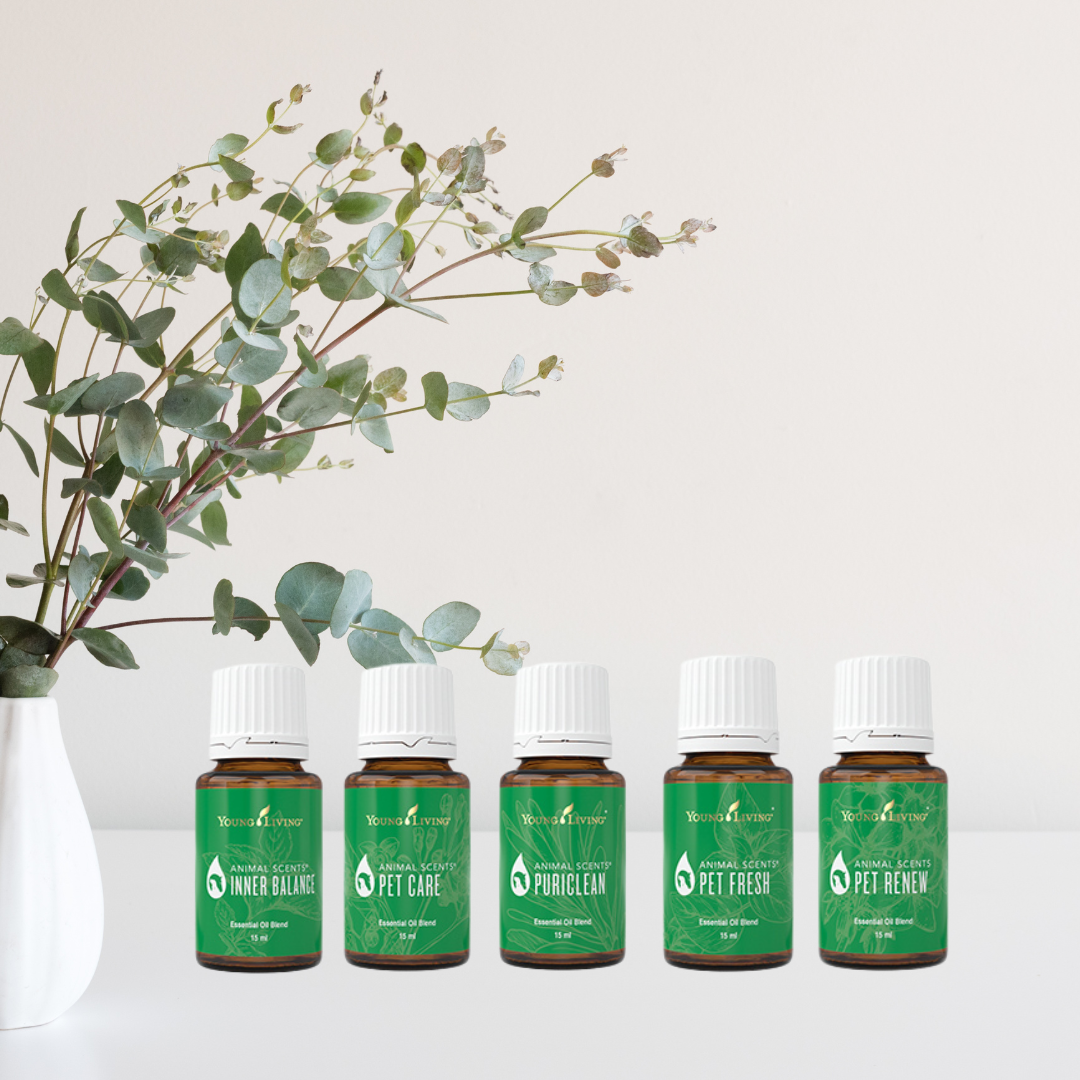
My people, this is where Young Living shows its commitment not only to our health but also to the health of those special beings that brighten our days! The Animal Scents line is the answer to our need to use essential oils with our furry friends, but in a safe, effective way, and with the full backing of veterinary experts and formulators. These products are not a luxury; they are a conscious necessity for a toxic-free home.
Each product in the Animal Scents line has been meticulously formulated with dilutions and combinations of essential oils that are safe for the unique physiology of dogs, cats, and other animals. It's such a peace of mind to know we're using something specially designed for them!
Here are the stars of the collection:
- T-Away™ (or Pet Care): An Olfactory Caress for the Soul:
- Purpose: This blend is a true balm for the hearts of our companions. It is specifically designed to support emotional well-being, helping them find a state of calm and balance.
- When to use it: Let's imagine situations where our furry friends get stressed! A visit to the vet, a long car ride, those terrible thunderstorms, or the New Year's fireworks that make them so nervous. T-Away™ can also be a great support to promote a calm environment during the process of adapting to a new home or the arrival of a new family member.
- Main components: Includes oils like Tangerine, Lavender (Lavandula angustifolia), Sandalwood (Santalum paniculatum), Blue Tansy (Tanacetum annuum), and Valerian. Always formulated with safe dilutions for them.
- How to apply: It can be applied very diluted (one drop of T-Away in 5-10 ml of Young Living's V-6™ carrier oil) on the animal's neck, chest, or ear tips (avoiding the inside). It is also excellent for very light diffusion (1-2 drops in the diffuser) or to lightly scent a bandana they can wear. With cats, the "aromatic petting" method (described later) is the safest, always using the Animal Scents line.
- PuriClean™ (or Pet Fresh): Freshness and Comfort for Their Skin:
- Purpose: This blend is our ally when the skin of our furry adventurers needs a little comfort and cleansing. It helps to soothe the skin after exposure to external elements, minor scratches, or simply to keep it clean and support its well-being.
- When to use it: After a walk in the countryside where they may have encountered irritating vegetation, if they have a superficial scratch from rough play, or to support the general well-being of the skin. It's also fantastic for neutralizing persistent odors in their coat without resorting to harsh chemicals.
- Main components: Oils like Patchouli (Pogostemon cablin), Lemongrass (Cymbopogon citratus), Lavender (Lavandula angustifolia), Purification (a Young Living blend), and Myrrh (Commiphora myrrha).
- How to apply: Always, always, super diluted. One drop of PuriClean™ per 10 ml of V-6™ carrier oil and apply directly to the desired area of the skin, massaging gently. For a refreshing coat spray, you can add 2-3 drops to a 2 oz (60 ml) spray bottle with distilled water and a pinch of unscented detergent, shake well, and spray lightly on the coat, avoiding the face.
Dilution is the Secret to Success!
Even with the Animal Scents line, proper dilution is crucial. A Chihuahua is not the same as a Great Dane, right?
- For small dogs (under 15 lbs / 6 kg): One drop of the Animal Scents oil in at least 1 teaspoon (5 ml) of carrier oil (like Young Living's V-6™ Enhanced Vegetable Oil Complex).
- For medium dogs (15-45 lbs / 6-20 kg): One drop of the Animal Scents oil in 1/2 teaspoon (2.5 ml) of carrier oil.
- For large dogs (over 45 lbs / 20 kg): One drop of the Animal Scents oil in 1/4 teaspoon (1.25 ml) of carrier oil.
Remember, always perform a patch test on a small area of skin first (like the inner thigh or armpit) and watch for any adverse reaction before a wider application. Our furry friends' skin is delicate, and we want to care for it with all our love.

The First-Aid Duo: Lavender and Frankincense for Your Fur Babies
If you had to choose two "universal" and safe essential oils that every home with pets should have, they would undoubtedly be Lavender and Frankincense. They are like those reliable friends who never fail, gentle yet powerful, and with a spectrum of benefits that also extends to our four-legged companions.
- Lavender (Lavandula angustifolia): Nature's Calming Embrace
- Main active components: Esters (linalyl acetate) and alcohols (linalool). These components are known for their relaxing and calming properties.
- Mechanisms: Linalool and linalyl acetate act on neural receptors, including GABA-A, which contributes to a natural sedative and anxiolytic effect.
- How to use it on pets: Young Living's Lavender is wonderful for promoting a calm environment and reducing mild stress. It's ideal for gentle massages, helping to relax tense muscles (for example, after a very active day) or to support restful sleep. It is also excellent for soothing dry or superficially irritated skin.
- Calming Massage Recipe for Mild Anxiety (Dogs & Very Diluted for Cats!):
- Descriptive Name: Gentle Lavender Slumber
- Ingredients:
- 1 drop of Young Living Lavender (Lavandula angustifolia) Essential Oil
- 10 ml of V-6™ Enhanced Vegetable Oil Complex (or food-grade fractionated coconut oil)
- Application instructions: Mix the drop of Lavender in the carrier oil. Rub a small amount (pea-sized) in your hands until it's almost absorbed. Gently stroke along the dog's back, avoiding the face and eyes. For cats, this dilution is even more critical: just a "touch" of the mixture rubbed on your hands and only stroking the back and the base of the tail, never directly on the skin, but on the fur, for minimal ingestion during grooming. Frequency: Once a day or as needed, always observing the animal's reaction.
- Precautions: Avoid applying near the eyes, nose, or genitals. Always dilute generously.
- Frankincense (Boswellia carterii): The King of Oils for Overall Wellness
- Main active components: Monoterpenes (alpha-pinene, limonene) and sesquiterpenes (beta-caryophyllene). Boswellic acids, although non-volatile, are its main non-volatile component.
- Mechanisms: It has been studied for its effects on modulating the inflammatory response via the NFκB pathway and for its ability to promote cellular regeneration and support the immune system.
- How to use it on pets: Frankincense is a wonderful oil for supporting cellular health and systemic balance. It is excellent for soothing aging skin or for providing general wellness support. It is also known to contribute to an environment of serenity and connection.
- Care Oil Recipe for Aging Skin (Dogs):
- Descriptive Name: The Golden Wellness Elixir
- Ingredients:
- 1 drop of Young Living Frankincense (Boswellia carterii) Essential Oil
- 5 ml of V-6™ Enhanced Vegetable Oil Complex
- Application instructions: Mix one drop of Frankincense with the carrier oil. Gently apply a small amount (almond-sized) once a day on dry or flaky areas of the dog's coat, massaging gently. For cats, this application should be considered with extreme caution and only if there is a specific need and with an even higher dilution (1 drop of frankincense in 10-15 ml of carrier), applied only with an indirect and sparse "petting" method.
- Precautions: Although it is one of the gentlest oils, always dilute. Avoid eyes and mucous membranes.
3 Safe Ways to Introduce Oils to Your Pet
The key to making aromatherapy a success with our furry friends is patience, observation, and, of course, safety. Here are the most respectful and effective ways for your companions to enjoy the benefits of essential oils.
1. Light and Open Diffusion: The Safest Method
This is the Gold Standard method, especially for our sensitive feline friends. Diffusion allows aromatic particles to disperse gently into the air, creating a pleasant and therapeutic environment without direct, concentrated exposure.
- How to do it:
- Choose your diffuser: A Young Living ultrasonic diffuser is ideal. It uses water and does not heat the oils, maintaining their purity.
- Amount of oil: Start with just 1 or 2 drops! Yes, one or two for a diffuser with 100-200 ml of water. Remember, their nose is super powerful.
- Recommended oils: Lavender, Frankincense, Copaiba, or any from the Animal Scents line like T-Away™.
- Duration: Diffuse for short periods, 15 to 30 minutes. Then, turn off the diffuser and let the air ventilate.
- The Golden Rule: The most important thing is that the room must ALWAYS have an open door or window, allowing the animal to leave the space if the scent is too strong or if they simply don't feel like it. Observe their behavior: if they sneeze, lick excessively, leave the room, or show signs of discomfort, it's a sign that you should stop or reduce exposure.
- Consideration for cats: For cats, diffusion is the only reliable way to use oils. Keep the diffuser in an open, ventilated area, away from their main resting spot.

2. The "Petting" or Aromatic Touch: A Loving Bond with Purpose
This method is a beautiful way to integrate essential oils into your pampering and stroking routine, creating an even deeper bond with your companion, especially with dogs. For cats, this method must be done with extreme dilution and through a scratching post or blanket, not directly on them, to avoid ingestion.
- How to do it (for dogs):
- Dilution: In the palm of your hand, add 1 single drop of a safe essential oil (like Lavender or Frankincense) to 1 tablespoon of V-6™ Enhanced Vegetable Oil Complex. Mix well by rubbing your palms together.
- Application: Rub your hands together until the mixture is almost completely absorbed into your skin and the scent is very subtle. Then, gently stroke your dog along their back, chest, or the base of their tail. Avoid the face, eyes, nose, inner ears, and genital areas.
- Benefit: You are not only applying the oil safely but also providing a moment of relaxation and connection through touch.
- Frequency: Once a day or as needed, always observing your dog's reaction.
- How to do it (for cats, indirect method):
- Extreme dilution: Use the same dilution as for dogs, but instead of applying it directly to the cat, rub your hands until the oil is barely perceptible.
- Indirect application: Stroke a blanket they use, their scratching post, or a favorite toy (not one they will chew on). Allow the cat to choose to interact with the scented object. This gives them control and minimizes any potential irritation. Never apply it directly to their fur or skin.
3. Spray for Their Beds and Blankets: Freshness and Well-being in Their Space
Creating a scented spray is a fantastic way to refresh your pet's space and offer a calm environment, without exposing them directly to oils if they don't want it.
- How to do it:
- Ingredients:
- 2 oz (60 ml) of distilled water or Lavender/Chamomile hydrosol.
- 1 to 2 drops of a safe essential oil (Lavender, Frankincense, or T-Away™ from Animal Scents).
- A pinch of Epsom salts or witch hazel to help disperse the oil.
- Preparation: In a 2 oz glass spray bottle, add the Epsom salts/witch hazel, then the essential oil drops, and fill with distilled water. Shake well before each use.
- Application: Lightly spray your pet's beds, blankets, or fabric toys. Let it dry before the animal interacts with the object.
- Benefit: Ideal for neutralizing odors and creating a relaxing atmosphere in their resting areas.
- Precaution: Always ensure the spray does not come into direct contact with the animal or is ingested. Do not spray in food or water bowls.
With these three safe methods, my beautiful people, you can begin to integrate the power of aromatherapy into your pets' lives. Always remember to start slowly, observe, and adjust according to the individual needs of each of your darlings. That is the true art of wellness!
Frequently Asked Questions (FAQ)
Here I'll answer those questions that arise with so much love and responsibility, so that tranquility may reign in your homes.
What essential oils are toxic to cats?
Oh, my people, this is the key question for the safety of our feline friends! For cats, the most toxic essential oils, which must be absolutely avoided, are: all citrus oils (Lemon, Orange, Bergamot, Tangerine, Grapefruit) due to d-limonenes; Tea Tree/Melaleuca (Melaleuca alternifolia), which is highly toxic to them; and oils rich in phenols (Clove, Oregano, Thyme, Wintergreen, Cinnamon), those rich in ketones (Hyssop, Sage), and those rich in monoterpenes (Pine, Fir). The lack of the glucuronyltransferase enzyme in their liver prevents them from properly metabolizing these compounds, leading to their accumulation and toxicity.
Can I put essential oils in my dog's shampoo?
Yes, you can add essential oils to your dog's shampoo, but with extreme caution and dilution! Choose gentle and safe oils like Lavender (Lavandula angustifolia) or Frankincense (Boswellia carterii), or blends like PuriClean™ from the Animal Scents line. Use 1 or 2 drops maximum per 1 oz (30 ml) of dog-specific shampoo (without artificial fragrances or harsh chemicals). Make sure to mix very well before applying and rinse thoroughly so no residue remains on the coat. Avoid contact with eyes, nose, and mucous membranes. Do not do this with cats!
How can I calm a dog scared of fireworks using aromatherapy?
To calm a dog scared of loud noises like fireworks, aromatherapy can be very supportive. The T-Away™ (or Pet Care) blend from Young Living is ideal for this. You can diffuse 1-2 drops in a diffuser with plenty of water in a room with an open door, at least 30 minutes before the event. You can also use the "aromatic petting" method, diluting one drop of T-Away™ or Lavender in 10 ml of carrier oil, rubbing it in your hands until the scent is subtle, and then stroking the dog's back. Repeat as necessary, always offering a safe refuge and your company.
Are essential oils safe for puppies and kittens?
For puppies and kittens, the skin is even more sensitive and their liver system is still developing, which makes them extremely vulnerable. It is crucial to be even more cautious. For kittens, very light environmental diffusion with plenty of ventilation, using only safe oils like Lavender or Frankincense, is the only recommended method, and only if the kitten has access to leave the area. Topical application on pets under 8 weeks old is generally discouraged. For puppies, always use extreme dilution (1 drop in at least 15-20 ml of carrier oil) and only under supervision. If you have any doubts, consult a veterinarian with experience in aromatherapy.
What is the difference between oils for humans and the Animal Scents line?
The main difference lies in the dilution and selection of oils. Although Young Living essential oils are 100% pure and therapeutic-grade for humans, the Animal Scents line is PRE-DILUTED with a blend of carrier oils and formulated with combinations of essential oils that have been studied and deemed safe specifically for the physiology of dogs and cats. This minimizes the risk of overdosing or exposure to compounds that could be harmful to them. It's an additional layer of safety and confidence, designed for their overall well-being.

Your Home, A Sanctuary of Love and Well-being!
Oh, my beautiful people! After this journey through the fascinating and delicate world of aromatherapy for our pets, I hope you feel more empowered, more confident, and with your hearts full of the certainty that you are providing the best for those beings who give us so much. Because love is shown with knowledge, with caution, and with the choice of products that truly care for their overall well-being.
Transforming our home into a toxin-free sanctuary is an act of love; protecting our two- and four-legged family with natural and safe solutions is a commitment. The Young Living Animal Scents line, along with pure oils like Lavender and Frankincense, are the tools we need to fulfill that promise. It's not just about making it "smell nice," but about nurturing their physical and emotional health in the most respectful way possible.
So, my beautiful people, it's time to take the step! Let's empower ourselves with information, choose purity and safety, and continue to build homes where harmony, joy, and health are for everyone, especially for those loyal companions who look at us with such devotion. Your heart and the hearts of your furry friends will thank you for it!
[Click here to explore the Animal Scents collection and transform your pets' well-being today on Esseniq.es!](https://www.esseniq.es/)
Disclaimer
Warning Signs to Consult a Veterinarian: If your pet shows symptoms such as lethargy, vomiting, diarrhea, tremors, difficulty breathing, excessive drooling, lack of coordination, drastic behavioral changes, or any other health concerns, immediately discontinue the use of essential oils and consult a veterinarian urgently. The use of essential oils is complementary and does not replace professional veterinary care.
These statements have not been evaluated by the FDA. The information provided in this article is for educational purposes only and is not intended to diagnose, treat, cure, or prevent any disease. Always consult a qualified healthcare professional before implementing any changes to your pet's health regimen, especially if they are pregnant, nursing, taking medication, or have a pre-existing medical condition. All essential oils mentioned are from Young Living, therapeutic grade, and Seed to Seal® Certified.
Hashtags
#petaromatherapy #AnimalScents #YoungLivingPets #EssentialOilsForDogsAndCats #animalwellness #toxinfreehome #safeoilsforpets #responsiblecare #EsseniqPets
---